

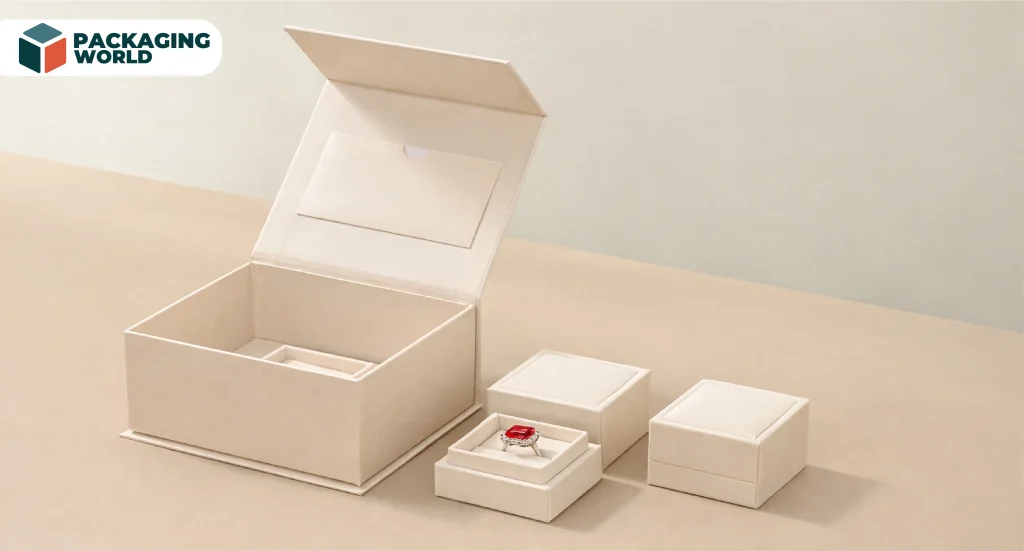
We’ve all seen that breathless moment, the velvet lid clicks open, the light hits the stone just right, and for a split second, time stands still. In that flash, the packaging is the only thing standing between your craftsmanship and the customer’s emotional reaction.
The size of your ring box is far more than a logistical choice; it is the frame that determines the perceived value of the masterpiece inside. A box that is too large can make a delicate solitaire look small and lost, diminishing the impact of the stone. Conversely, a box that is too cramped feels cheap, suggesting that the jewelry was an afterthought rather than a treasure.
In this guide, we are breaking down the technical dimensions, internal clearance, and structural logic to help you select a size that turns a simple purchase into a lifelong memory.
What Should Be the Size of Your Ring Boxes?
Standard Dimensions of Ring Boxes vs. The “Slim” Revolution
Choosing the right footprint for your custom ring boxes depends entirely on the “moment” you are trying to create. In the jewelry world, three specific geometries dominate the market, each serving a distinct psychological and functional purpose.
The Classic Square (2” x 2” x 1.75”) inches: The 50mm x 50mm x 45mm square remains the undisputed industry standard for traditional retail. This “high-profile” cube is engineered for the showroom; its height allows it to stand tall in a glass display case, catching the maximum amount of overhead light. It provides ample vertical clearance for high-set cathedral mounts and large carats, ensuring the lid never grazes the prongs.
The “Pocket-Friendly” Slim Box (2” x 2” x 0.75”) inches: For surprise proposals, discretion is the primary engineering requirement. The rise of the 50mm x 50mm x 19mm “slim” box has revolutionized the engagement experience. By utilizing a low-profile rigid board and a fold-flat hinge, this design eliminates the tell-tale bulge in a jacket or trouser pocket. It’s a tactical choice for brands that want to support the “covert” nature of a surprise moment without sacrificing the “snap” of a luxury closure.
The Double Ring Box (3” x 2” x 1.5”) inches: When transitioning to wedding sets, the geometry shifts to a rectangular landscape. A 75mm x 50mm x 38mm size is the benchmark for double-ring displays. This width is calculated to ensure both the engagement ring and the wedding band sit harmoniously side-by-side. The extra internal real estate prevents the metals from touching or scratching during transit, presenting the set as a unified, cohesive pair.
Sizing Quick-Reference
- Retail Display: 2″ (L) x 2″ (W) x 1.75″ (H) — Optimized for maximum light exposure in glass cases.
- Proposals: 2″ (L) x 2″ (W) x 0.75″ (H) — Optimized for maximum discretion and pocket fitting.
- Ceremony: 3″ (L) x 2″ (W) x 1.5″ (H) — Optimized for side-by-side presentation of wedding sets.
Internal Geometry: The Importance of Clearance
Engineering a ring box requires a deep understanding of vertical clearance. The Foam Insert Factor is the most critical technical detail; you must maintain a “headroom” safety margin of at least 10 mm to 15 mm above the stone. This prevents the underside of the lid from making physical contact with the prongs, which can cause micro-scratches or even loosen the setting during transit.
Furthermore, you must account for Ring Guard Considerations. High-set cathedral mounts or wide, chunky bands require deeper internal slots and taller lids to prevent the box from appearing forced shut. If the lid exerts pressure on the ring, it compromises the “snap” of the magnetic closure and suggests a lack of professional precision. By calculating the exact arc of the band and the height of the mount, you ensure a secure, friction-fit display that showcases the jewelry without restricting it.
Clearance in Ring Boxes
- Headroom: Always allow 12mm of air between the gem and the lid.
- Slot Depth: Ensure 60% of the band is submerged for stability.
- Mount Height: Tall stones require a minimum box height of 45mm.
- Lateral Space: Ensure 5mm of space on either side of the band to allow for easy retrieval.
Material Impact on External Volume
When calculating the dimensions of your custom ring boxes, you must account for the “wall thickness” of your chosen material. This is a common oversight that can lead to internal overcrowding.
- Wooden Boxes: Typically require a wall thickness of 5mm to 8mm. While they offer a prestigious, heavy hand-feel, their external volume is significantly larger than their internal capacity. A 2″ external wood box may only offer a 1.4″ internal clearance.
- Velvet/Plastic Shells: These use thin injection-molded plastic (1.5mm wall), maximizing internal space. These are ideal when you need a compact footprint but have a high-set stone.
- Rigid Paperboard (Greyboard): Our preferred standard. At 1000gsm to 1200gsm, these boards offer a 2mm wall thickness. This provides the perfect balance: high structural durability and a premium feel without adding excessive bulk to the external dimensions.
Volume Tip: If you are transitioning from paperboard to wood, increase your external dimensions by 20% to maintain the same internal clearance for the ring.
Scaling for Branding and Logistics
Precision in sizing extends to your entire supply chain. When designing Unboxing Layers, your ring box must fit your custom shipping mailers with zero “rattle.” A loose fit suggests a lack of attention to detail, while a snug, engineered fit reinforces brand quality. Similarly, Retail Display Logic dictates that your box dimensions must align with standard jewelry case tiers. Uniform sizing allows for clean “shelf facings,” enabling you to stack or grid multiple units without creating visual clutter, ensuring your brand presents as a disciplined, high-end collection.
Custom Sizing for High-Value Commissions
Bespoke jewelry demands Bespoke Dimensions. When moving beyond standard solitaire sizes to accommodate statement multi-stone anniversary bands, standard geometry often fails. These high-value commissions frequently feature lateral architecture, clusters or halo settings that require wider internal cavities to avoid rubbing against the box walls. Deviating from the standard 50mm width ensures that complex, wide-set pieces remain the focal point, protected by a frame that respects their unique physical footprint and artistic scale.
Key Takeaways: Bespoke Ring Box Dimensions
- Avoid the “Rub” Risk: Standard 50mm widths often cause lateral abrasion for clusters and halos. Custom sizing is a protective necessity, not just an aesthetic choice.
- Architectural Respect: Statement pieces feature “lateral architecture” (width-heavy designs) that requires internal cavities to be scaled proportionally to the setting, not just the band.
- Focus through Framing: Deviating from standard dimensions ensures the box acts as a deliberate frame that honors the scale of the commission rather than making it look cramped or oversized.
- Security through Scale: A bespoke footprint ensures that high-value multi-stone bands are held securely by a frame that respects their unique physical footprint, reducing movement during the “reveal.”
Your jewelry represents a significant investment; your packaging should too. At The Packaging World, we specialize in engineering custom ring boxes that provide the perfect frame for your artistry. Connect with us to design a size that feels as premium as the diamond it holds.


